The Silence We Broke · Standalone Novel
Prologue
Read the prologue from Sheldon Kornyk’s complete adult science-fiction novel, The Silence We Broke.
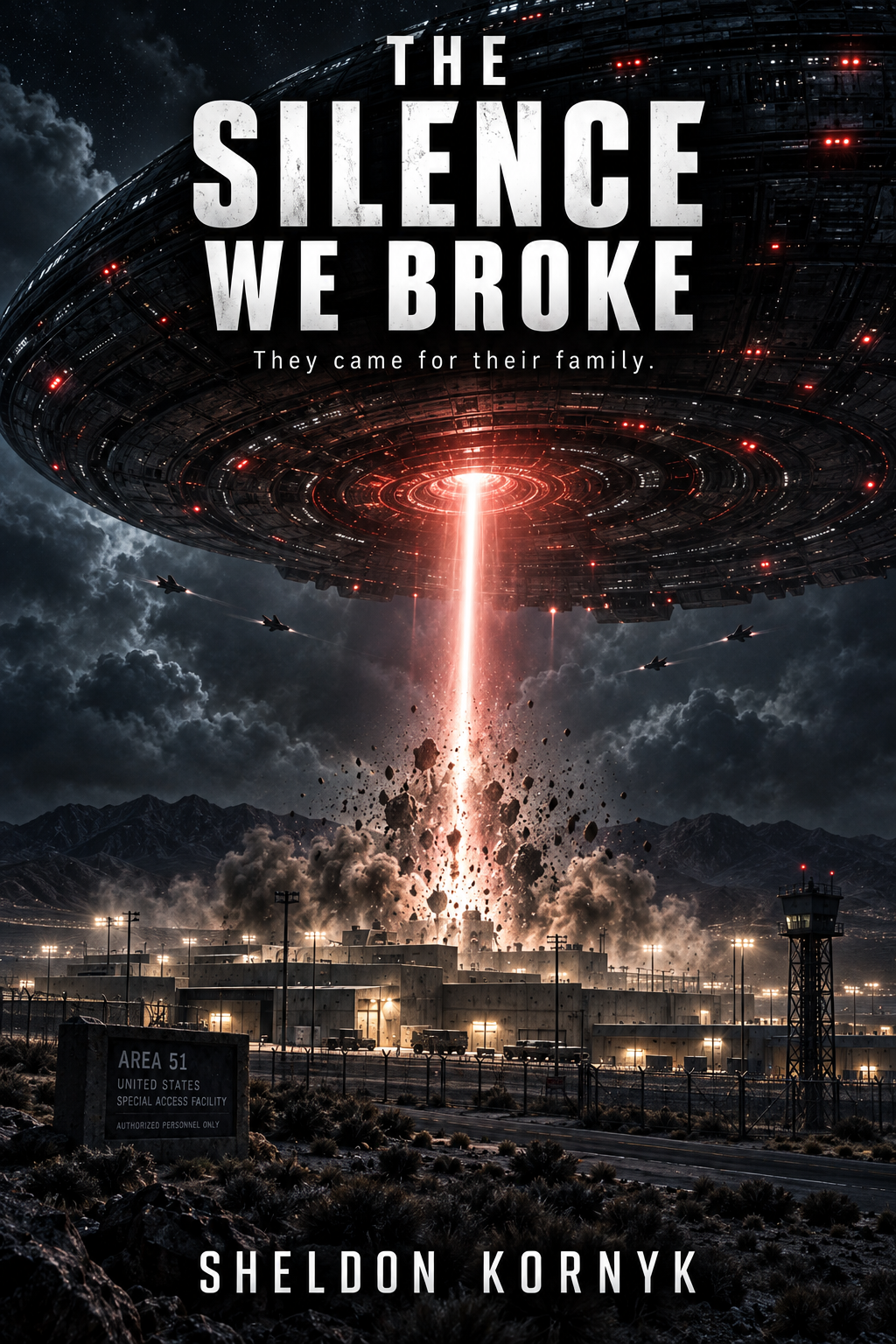
The thing in Chamber Four was watching him.
Daniel Rusk stopped with his hand above the control.
Through the observation window, beyond the technicians and their instruments, the captive hung in a column of pale fluid. Its head had turned. Its eyes were open.
He had never seen them open before.
“Doctor?”
Rusk looked at the woman beside him. Her finger rested on the test sequence. Nine months of preparation had brought them to this bench; she was waiting for him to let her begin.
“Hold.”
He stepped closer to the window.
The chamber glass distorted the narrow face. Tubes entered beneath its jaw and disappeared into the harness around its chest. One arm ended below the elbow. Rusk had read the report explaining why. There had been photographs.
He had not looked at them twice.
The remaining hand moved against a restraint.
“Is Four awake?”
At the monitoring station, a technician checked his display.
“No change in cortical activity.”
“Its eyes are open.”
“Reflex response. We get them sometimes.”
Rusk had worked six levels beneath the Nevada desert for eleven years. He knew the protocols, the euphemisms, the penalty for taking a sheet of paper past the last security door. He knew the woman who catalogued tissue samples had a daughter at medical school and that the night supervisor brought homemade bread on Fridays.
He knew almost nothing about the living creature on the other side of the glass.
They called it Four because that was the chamber it occupied. The first three chambers were empty.
Disinfectant stung Rusk’s nose. Beneath his shoes, the pumps pulsed steadily.
“We can postpone,” he said.
Director Bell looked up from the back of the room.
“On what grounds?”
Rusk gestured toward the window. Bell studied the captive, then the technician’s display.
“The subject has exhibited movement throughout containment. Proceed.”
On the test bench sat a black object no larger than Rusk’s closed hand. It had been recovered from the wreck with the occupants forty years earlier. Hundreds of experiments had produced nothing except heat, damaged instruments and several ruined careers.
Then a scan had revealed a hairline fracture beneath its casing.
Not a sealed device.
A broken one.
They had repaired the connection that morning.
Rusk returned to the bench.
“Lowest input. Ten seconds only.”
The woman beside him began the sequence.
For two seconds, nothing happened.
Then the object lifted off the bench. It rose perhaps a centimetre. Enough for its shadow to detach from the surface. Every conversation in the room stopped.
A narrow white line appeared around its middle.
Beyond the window, Four pulled hard against the harness.
“Stop the test,” Rusk said.
The woman disconnected the supply.
The object remained suspended.
“External power is off.”
“Then why is it—”
A fist struck the chamber glass.
Everyone turned.
Four had freed its hand. It struck again, slowly, with what looked like enormous effort. Its mouth moved around the tubes beneath its jaw.
“Increase sedation,” Bell said.
Rusk barely heard him. The wall display showed something that made no sense: power consumption in the adjoining hangar had fallen to zero, yet every sensor around the recovered craft was active.
The ship was supplying itself.
And something else.
“Clear the bench.”
White light flared between his fingers as he reached for the device. Heat hit his palm. He recoiled, knocking his chair over.
The woman caught his sleeve before he fell.
Blood welled through a split in his glove.
Then the alarms began.
In the hangar camera view, lights moved beneath the wreck’s scorched hull. A section they had cut open thirty years earlier was drawing itself together.
Rusk pressed the intercom.
“Hangar personnel, evacuate. Leave the equipment.”
Two figures moved away from the craft. One stopped to collect a case.
“Leave it!”
The hangar lights failed. The ship remained visible, outlined by a dull red glow.
The technician at the monitoring station stood so suddenly that his headset tore loose.
“We have an emission.”
“Radiation?” Bell asked.
“I don’t know. The roof array registered it. So did the surface perimeter.”
Rusk looked at the black object. The white line had become a circle of moving points.
“Put it in the shielded enclosure.”
“We can’t touch it.”
“Move the enclosure around it.”
They rolled the shielding unit over the bench. The woman slammed its cover down. A locking mechanism engaged with a heavy click.
The room darkened as the cover enclosed the light.
Then the perimeter alarm sounded again.
“Still transmitting,” the technician said.
Bell was already at the secure telephone.
Rusk crossed to the observation window. Four had stopped struggling. Its hand rested against the curved glass, fingers spread. The monitor beside it showed the temperature of the fluid falling.
Its heart rhythm was changing too.
“We’re losing it,” someone said.
Rusk watched the readings settle.
“No.”
The irregular beat became steady. The body in the chamber straightened by degrees, lifting against the restraints. Whatever the ship was doing, it had reached the captive.
Four turned toward him. Rusk raised his uninjured hand without thinking.
The captive’s fingers curled away from the glass.
It looked past him, toward the shielding unit.
Every alarm stopped.
The sudden silence was so complete that Rusk could hear Bell breathing into the telephone.
“Emission has ceased,” the technician said.
Nobody moved.
“Confirm.”
“Surface and perimeter both clear. Nothing leaving the facility.”
Bell lowered the receiver.
“Seal this floor. Nobody goes off shift until we’ve reviewed the event.”
The woman beside the bench sank into her chair. Someone laughed once, too loudly, and apologized.
Rusk kept watching Four. Fluid trembled around its face. Its chest moved in short, uneven contractions that the monitoring software labelled respiratory distress.
But the readings remained stable.
It was watching the ceiling now.
As though the floors, the reinforced concrete and the desert above them were no longer there.
As though he knew someone was coming.
***
Across a distance human transmitters would have needed generations to cross, a receiver sounded in a room overlooking a dark ocean.
The emergency channel had carried nothing for forty Earth years.
The vessel it belonged to was listed as lost.
Commander Sareth arrived without fastening her uniform. An officer met her at the door and began explaining how they had authenticated the signal.
She walked past him.
“Show me.”
A ship’s identification filled the display. She knew it before the full sequence appeared.
Her brother had served aboard that ship. On the day it left, he had complained that a survey assignment would give him nothing worth telling her when he returned.
She had told him to make something up.
“Survivors?”
“One confirmed. The emergency system briefly reconnected with a crew medical implant. Others may be beyond its range.”
Sareth brought the record closer.
The identification belonged to her brother. She gripped the edge of the display, unable to read past his name.
“Is he injured?”
The officer did not answer quickly enough.
She opened the medical history.
The implant had stored what it could during the decades without contact. Dates ran down the display. Major tissue loss. Chemical exposure. Restraint. Injuries repeated after earlier wounds had healed.
Some records were incomplete. Others contained measurements that could not possibly describe emergency treatment.
Sareth stopped at the removal of his arm.
His neurological responses had been recorded throughout.
“Was he aware?”
The officer lowered his head.
“Yes.”
Outside, waves broke against the seawall. A service vehicle passed beneath the window, its lights moving over wet stone. Somewhere in the building people were beginning an ordinary shift.
Salt air touched Sareth’s face. Her brother had been alive through every day she had spent learning to live without him.
“Location?”
A yellow star appeared. Then its third planet, blue beneath white cloud.
The signal had fixed a point on a continent in the northern hemisphere.
Under the surface.
“The population?”
“Unknown. The approach records suggest a technological civilization. We cannot assess their defences from this transmission.”
Sareth studied the last readings. The ship had delivered an emergency treatment pulse before the damaged link failed. Her brother’s condition had improved.
He was alive.
For now.
“Prepare the medical carriers.”
“And request an armed escort?”
She looked once more at the years of injury beneath her brother’s name.
One ship would have brought him home before all this happened.
“Wake the fleet.”
Excerpt from The Silence We Broke. Copyright © 2026 Sheldon Kornyk. All rights reserved.
