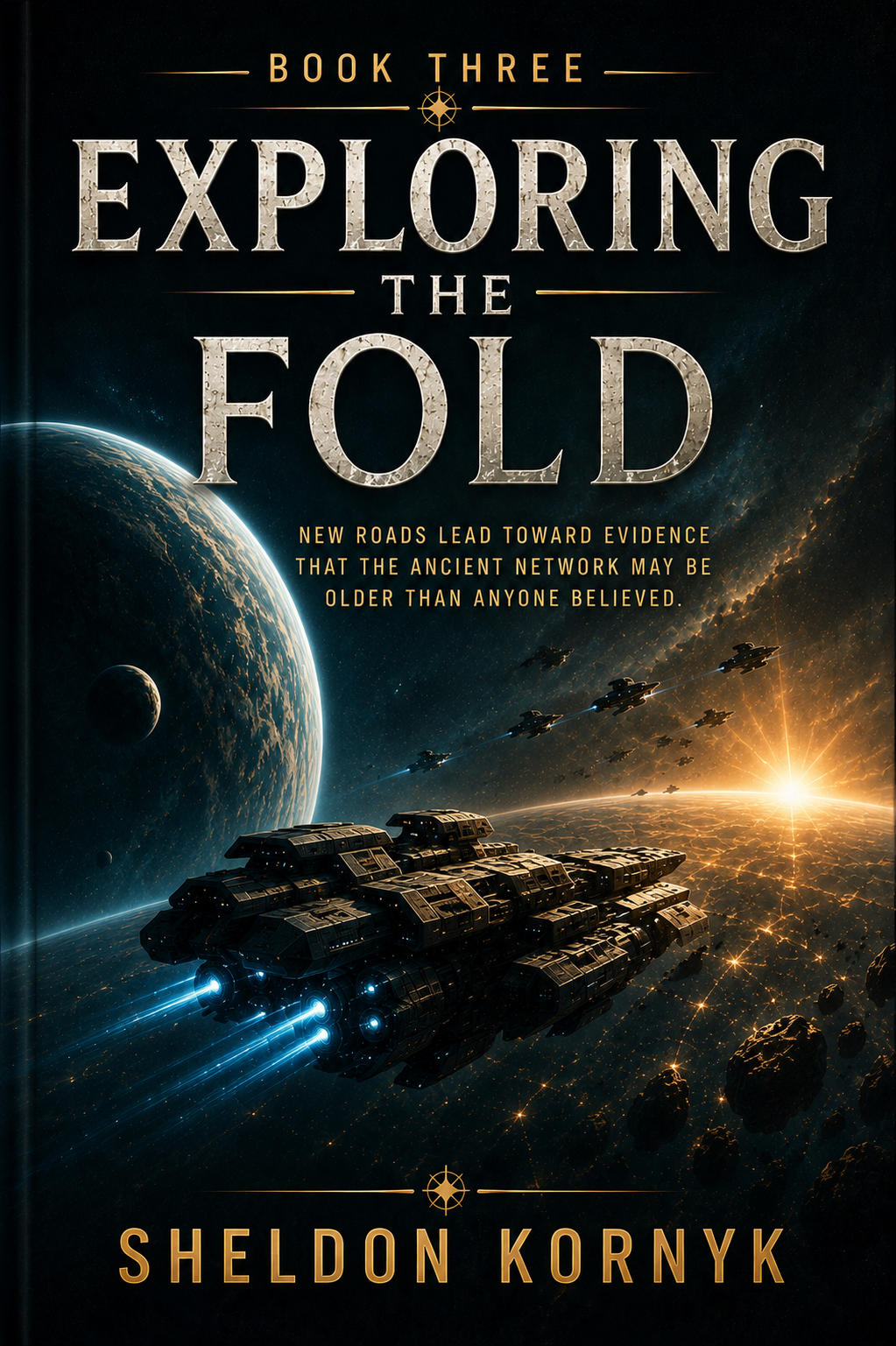
Exploring the Fold · Book Three
Prologue: Before the Builders
Read the opening of Exploring the Fold by Sheldon Kornyk.
Prologue
Before the Builders
They thought they had discovered it.
That was the first mistake.
The second was believing discovery and ownership meant the same thing.
The world had no name anymore. Not one that survived.
What remained of it circled a dim white star at the edge of a region later civilizations would map, abandon, rediscover, rename, and misunderstand. Its sky was pale, its oceans dark, and beneath a mountain older than every city on the planet, nine black structures waited inside the stone.
At first, they called them pillars.
That name survived for twenty-eight years.
It was wrong.
They were towers.
Most of each structure remained buried vertically beneath the excavation, extending farther down than any instrument could follow. The exposed portions were smooth, black and seamless, arranged in a geometry nobody could explain.
Nine structures.
Nine positions.
Nine points in a pattern too deliberate to be natural.
They had not built them.
They knew that much.
At first, that knowledge had been humiliating.
Then exhilarating.
Then dangerous.
For thirty-seven years, the towers did nothing.
Researchers touched them. Scanned them. Cut samples from the surrounding stone. They built laboratories into the mountain and filled them with instruments that became obsolete while the structures remained unchanged.
Governments funded the work, questioned it, cancelled it, then funded it again.
Scientists argued over them.
Politicians fought over them.
Everyone named them.
Then renamed them.
Nothing changed.
The black material resisted every tool they possessed. It did not corrode. It refused to conduct heat in any predictable way, and mass analysis produced results that changed depending on how the measurements were taken.
They excavated deeper.
Ten metres.
Fifty.
Then hundreds.
Still the structures continued downward.
No base.
No foundation.
Nothing suggesting they had ever been constructed from the surface at all.
Then one day, one point illuminated.
There was no warning.
No vibration.
No energy surge their sensors could explain.
Just light.
White.
Clean.
Steady.
One researcher had been standing inside the excavation chamber when it happened.
Her name was Tal Vara.
That survived.
Barely.
Later civilizations would translate her title incorrectly.
Engineer.
Physicist.
Keeper.
None were quite right.
Vara had been someone whose job was to ask dangerous questions and refuse easy answers.
Which was probably why she stepped closer.
The others told her not to.
She ignored them.
That survived too.
Vara approached the nearest tower.
She did not touch it.
The light moved.
Not toward her.
Around the chamber.
A second tower illuminated.
Then a third.
Within seconds, all nine were burning white.
The mountain shook.
Not violently.
Deeply.
Stone groaned around them. Dust fell from the ceiling. Warning tones erupted through the laboratory complex.
Then the floor moved.
Vara stumbled backward.
The others ran.
She stayed.
The first tower rose.
Not quickly.
Not like machinery forcing itself upward.
It emerged from the mountain as though the stone had simply decided to release it.
Metre by metre, the black structure climbed.
Then the second.
The third.
All nine.
The chamber ceiling split along seams nobody had known were there.
Massive sections of ancient stone retracted.
Fresh air rushed downward.
Daylight entered the excavation for the first time in thirty-seven years.
The towers continued rising.
When they finally stopped, the exposed structures reached hundreds of metres above the mountain.
Nine black forms against a pale sky.
Perfectly aligned.
Vara stood between them and stared upward.
Nothing opened.
No doorway.
No visible portal.
No window onto another place.
The towers simply stood there.
Waiting.
Then every orbital station above the planet began transmitting alarms.
Something had appeared in space.
Thousands of kilometres above the atmosphere, well beyond normal traffic lanes, a distortion had formed.
It had not approached.
It had not accelerated into position.
One moment the region of space had been empty.
The next, it was not.
Light bent around a boundary their instruments could detect but could not properly measure.
Stars behind it stretched.
Gravimetric sensors contradicted one another.
Rangefinders returned impossible values.
Some instruments claimed the distortion was a few hundred metres across.
Others said several kilometres.
One returned no distance at all.
Vara watched the orbital feeds.
One of the researchers beside her whispered:
“What did we open?”
Vara looked from the image above the planet to the nine towers surrounding them.
“No.”
The researcher turned.
“What?”
She pointed upward.
“That isn’t here.”
Silence.
Then Vara looked at the towers again.
“These aren’t the doorway.”
That sentence survived.
Much of what followed did not.
The towers remained active for forty-seven minutes.
Then, one by one, their lights went dark.
The distortion above the planet vanished with them.
Nobody slept that night.
For eleven years, they tried to make it happen again.
Thousands of experiments followed.
Careers were built and destroyed around those nine towers.
Equipment improved.
The excavation became a permanent research complex.
Arguments escaped the laboratories and entered universities, governments, courts and eventually streets.
There were accidents.
Two people died.
One government collapsed.
Three replaced it.
Through all of it, the towers remained exactly as they had been.
Silent.
Waiting.
Eventually, they learned something.
The towers were not generating the phenomenon in the way a machine generated heat or thrust.
They were establishing something.
A condition.
A connection.
A relationship.
That became the word they used.
Mass mattered.
Position mattered.
Energy mattered.
And something else mattered.
Something nobody could define.
On the eleventh year, they reproduced the activation.
The towers illuminated.
Their upper sections shifted by fractions of a degree.
Orbital Control reported the distortion seventeen seconds later.
This time, it remained for four minutes and twelve seconds.
Long enough to study.
Not long enough to understand.
They repeated it seven months later.
Then again.
Each time, the nine towers established the same geometry.
Each time, the distortion appeared in space.
And each time, nothing they transmitted through conventional means told them what existed beyond it.
So they sent probes.
The first carried little more than instruments, navigation systems and a transmitter.
It approached the distortion under autonomous control.
At three kilometres, telemetry became erratic.
At two, its navigational solution split into four incompatible positions.
At nine hundred metres, every system aboard went dead.
Not damaged.
Dead.
Power vanished.
Thrusters stopped.
Telemetry ceased.
Momentum carried the darkened probe past the distortion without crossing it.
They recovered it six hours later.
Its systems restarted normally.
Nothing was broken.
The second probe failed the same way.
So did the third.
They changed shielding.
Power systems.
Processors.
Control software.
Propulsion.
It made no difference.
Uncrewed machines could approach the Fold.
None could enter it.
At first they blamed interference.
Then geometry.
Then their own technology.
Vara blamed their assumptions.
“The structure isn’t rejecting the machine,” one engineer told her.
“How do you know?”
“Because machines don’t get rejected.”
Vara looked toward the orbital image.
“Then why hasn’t one crossed?”
He had no answer.
For nearly two years, the probes kept failing.
Eventually, they sent a crewed vessel closer.
Not to cross.
Nobody had authorized that.
The mission was supposed to determine why human-operated equipment continued functioning where autonomous machines failed.
Nine people went aboard.
Vara was one of them.
Of course.
The ship carried redundant systems, mechanical backups and a compact experimental relationship assembly based on the machinery surrounding the towers below.
It could not create a Fold.
Nobody believed it could.
Its purpose was to record how the Foundation behaved around a living crew.
The vessel approached slowly.
Five kilometres.
Three.
Two.
The captain watched the navigation display.
“That’s where the probes started losing coherence.”
Vara leaned forward.
“Closer.”
“No.”
“One kilometre.”
“No.”
“Nine hundred metres?”
The captain looked at her.
“Do you negotiate everything?”
“Only when I’m losing.”
He took them to nine hundred metres.
Nothing failed.
Vara stopped smiling.
Every probe had been dead by now.
The ship remained fully operational.
Power stable.
Navigation stable.
Life support stable.
“Hold position,” Vara said.
The captain was already trying.
“I am.”
The ship moved forward.
Thrusters fired.
It kept moving.
“Reverse.”
“Already reversing.”
The distortion grew across the forward displays.
Or perhaps they were falling toward it.
Their instruments could no longer tell the difference.
Five hundred metres.
Three hundred.
The engines pushed harder.
The ship accelerated forward.
Someone shouted.
Vara grabbed the edge of a console.
“Kill thrust.”
The captain turned.
“What?”
“Kill everything.”
He did.
For half a second, the ship seemed to stop.
Then space took them.
The vessel vanished.
Every signal from it stopped instantly.
No radio.
No telemetry.
No emergency burst.
Nothing.
Orbital Control watched the distortion and assumed nine people had died.
They were wrong.
Vara opened her eyes beneath an unfamiliar sky.
Alarms sounded across the bridge.
Several systems had reset.
One exterior sensor cluster was gone.
A section of hull had been scorched.
But the ship was intact.
So were the people inside it.
Outside stretched a world of rock and ice.
Stars filled the sky.
None matched home.
Behind them—
nothing.
The Fold was gone.
For the first time in years, Tal Vara had no immediate suggestion.
The captain looked at her.
“You wanted closer.”
Vara stared at the empty space behind them.
“I did.”
“Just making sure history gets that part right.”
It took six hours to establish that they were nowhere near their own system.
Another eleven to accept that they might never see it again.
They transmitted anyway.
Radio.
Directed beams.
Every frequency they could generate.
Nothing reached home.
Nothing came back.
They were alone.
Then Vara began studying the experimental relationship assembly.
Its physical components were unchanged.
Its stored state was not.
A pattern had appeared inside the system.
No programmer had placed it there.
It was not a coordinate.
Not a frequency.
Not a destination code.
The closest concept was the same one they had already been using on the planet.
Relationship.
Something had been written into the ship when they crossed.
Or into the system aboard it.
Vara spent two days trying to prove the pattern meaningless.
On the third, she stopped trying.
The captain found her on the engineering deck beneath an open panel.
Three engineers surrounded her.
“Tell me you’re fixing something.”
“No.”
“Vara.”
She looked up.
“We’re going home.”
That changed the room.
She showed him the pattern.
The ship had not generated the Fold.
It could not.
The energy required was beyond anything aboard.
But energy had apparently never been the important part.
The towers on their homeworld had established the original relationship.
The ship had crossed within it.
And during that crossing, something in the Foundation had recognized them.
Now their relationship assembly carried a record of that recognition.
A credential.
A memory.
A reference.
They argued over the word for decades afterward.
At the time, none of them cared what it was called.
They cared whether it could get them home.
They modified the assembly.
Nothing happened.
They changed the pattern.
Nothing.
They restored it.
Nothing.
Again.
Nothing.
On the seventeenth attempt, every light aboard the ship dimmed.
The stars ahead stretched.
Space bent.
The Fold appeared.
Nobody celebrated.
The captain stared at it.
“Is that home?”
Vara studied the readings.
“I have absolutely no idea.”
He looked at her.
“Comforting.”
“It’s the best answer I have.”
They crossed.
Forty-three minutes after disappearing, the vessel emerged into conventional space above its own world.
Orbital Control erupted.
The ship transmitted immediately.
Local radio.
Ordinary space.
Nothing had crossed ahead of them.
No message.
No telemetry.
No warning.
The ship had.
The people had.
The information they carried had.
That distinction became one of the first true rules they learned.
But not the most important.
They repeated the experiment.
Carefully this time.
First, another uncrewed probe.
It failed before the Fold.
They tried a different machine.
Same result.
Then they carried one of the failed probes aboard a crewed vessel.
It crossed.
They sent cargo.
It crossed with people.
They carried autonomous machines.
They crossed too.
Then they emptied the same ship and attempted to send it through remotely.
The vessel approached the distortion.
Its systems died.
It never crossed.
Again.
Again.
Again.
The result did not change.
Eventually the evidence became impossible to dismiss.
The Foundation did not require a pilot touching a control.
It did not care who commanded the vessel.
It did not require intelligence in any way they could measure.
But somewhere within the crossing—
a living traveller had to be present.
Why?
They had no idea.
Vara considered that the most important part.
They had discovered a rule.
They had not discovered its reason.
Matter crossed.
Information rode with matter.
And the living carried both.
Never alone.
The stone came later.
On the fourth successful crossing, Vara insisted they descend to the far world’s surface.
The captain objected.
Vara won.
She walked twenty-three metres from the landing site.
Picked up a dark piece of basalt.
Carried it back to the ship.
Then carried it home.
When she placed the stone on the laboratory table beneath the nine towers, no one spoke.
It was ordinary.
Mostly basalt.
But it had come from somewhere no vessel they had built could reach by conventional travel in a lifetime.
That stone changed civilization.
After that, everything accelerated.
They found more Foundation sites.
Some buried beneath mountains.
Some beneath oceans.
Some beneath cities whose inhabitants had lived above them for millennia without knowing.
Others existed on worlds where nothing living remained.
The architecture varied.
The towers varied.
Some installations exposed nine great structures to open sky.
Others kept most of them underground.
But the geometry remained.
Ninefold.
Always ninefold.
And wherever a viable Foundation site could establish a stable relationship—
a Fold could be opened in space.
Ships could cross.
Crewed ships.
Never empty ones.
The explorers carried their records with them.
Their samples.
Their measurements.
Their discoveries.
Information did not travel through the Roads by itself.
It travelled because someone carried it.
They built machinery around the ancient systems.
Improved their controls.
Learned how to preserve relationship states aboard vessels.
Eventually ships could request a previously established relationship from the far side, provided compatible Foundation architecture existed there.
They called those onboard systems many things.
Keys.
References.
Relationship engines.
Permission systems.
None were entirely correct.
The ships did not create Roads.
They asked.
The Foundation answered.
Sometimes.
They mapped routes.
Created crossings.
Built settlements.
Established networks.
What later peoples would simply call Roads.
The first generation treated every crossing as a miracle.
The second treated them as infrastructure.
The third complained about delays.
Vara lived long enough to see that.
She hated it.
“People get used to anything,” she said.
Her sister laughed.
“Even miracles?”
“Especially miracles.”
Then they discovered another civilization.
Not ruins.
Not records.
People.
Alive.
A survey ship crossed expecting an empty system.
Another vessel waited near the far-side Fold.
Neither side understood the other.
Both ships transmitted locally.
Neither understood a word.
Eventually each launched a crewed shuttle.
The two craft met in conventional space.
The strangers brought something with them.
A physical archive.
Images.
Mathematics.
Maps.
And one symbol.
Nine points.
Vara stared at it.
“They know.”
Her sister looked toward the strangers.
“Know what?”
Vara shook her head.
“No.”
She touched the symbol.
“They found it too.”
That was worse.
And better.
The strangers had built their own Road system.
Different machinery.
Different vessels.
Different relationship controls.
Same underlying Foundation.
Neither civilization had created it.
Both had inherited access to it.
The word inherited appeared repeatedly in Vara’s journals after that.
Later scholars removed it.
They preferred discovered.
Later still—
built.
History liked flattering words.
The first test of what connection actually meant came before anyone was ready for it.
A crewed courier ship crossed from the second civilization.
Only after emerging into ordinary space did it begin transmitting.
A coastal city on its homeworld had been shattered by a planetary quake.
Power systems were failing.
Hospitals were overwhelmed.
Millions of people were beyond the reach of what remained of the local transportation network.
The crew had not come asking for knowledge.
They had come asking for help.
For eleven hours, Vara’s world argued.
The other world was not theirs.
Its people were strangers.
Its disaster had not crossed the Road.
They could close the relationship and remain untouched.
Vara listened until she could not anymore.
“Then why did we open the Road?”
The first relief vessels crossed before the argument was officially over.
Crewed ships.
They carried surgeons.
Engineers.
Water purification systems.
Food.
Portable power.
And people willing to fly through a Fold because someone they had never met had asked them to come.
Years later, historians described that crossing as the beginning of the network.
Vara disagreed.
The network had begun when the first crew crossed.
Something else began that day.
Responsibility.
Once another world was reachable, distance could no longer pretend to be innocence.
The second civilization knew of a third.
The third knew of two more.
Some had discovered intact Foundation sites.
Others only ruins.
Some had built crude controls around ancient architecture.
Others possessed systems nobody else understood.
But all of them had made the same assumption.
Whatever lay beneath their Roads belonged to the universe.
Natural.
Ancient.
Unowned.
Then someone found the place between.
Not a Road.
Not an endpoint.
Something deeper in the Foundation.
A region that could be reached only by maintaining a relationship aboard a crewed vessel without fixing a conventional destination.
The first expedition lasted twelve days.
The crew called it the Dark Between.
The name survived.
That surprised everyone.
Inside it, they found structures.
Huge.
Silent.
Older than anything they had built.
They did not follow the familiar ninefold layout.
One stretched more than thirty kilometres.
Another appeared to have no meaningful front or back.
Most remained dark.
A few reacted when ships passed.
They did not attack.
They did not transmit.
They did not welcome.
They recognized.
The expedition returned carrying everything it had learned.
Physical recorders.
Samples.
Measurements.
Images.
Vara was old then.
Too old to travel.
She watched the archive brought into the laboratory by the returning crew.
Her hands were no longer steady when she touched an image of the largest structure.
For a long time, she said nothing.
Then:
“We are using someone else’s roads.”
Her sister’s grandson stood beside her.
“Whose?”
Vara smiled.
“That’s the right question.”
She died six days later.
The question survived.
Generations passed.
The networks expanded.
Civilizations joined.
Seventeen major systems eventually became connected.
Not one empire.
Not one people.
A web.
Ships carried trade between worlds.
Families crossed and sometimes never returned.
Ideas travelled because people carried them.
Physical archives moved aboard vessels from civilization to civilization.
Technology crossed.
So did art.
Language.
Religion.
Weapons.
For a while, it was extraordinary.
Then people became ambitious.
Connections multiplied.
Old routes were linked to new ones.
Networks designed under different assumptions were forced together.
Relationships overlapped.
And the first impossible thing happened.
A ship arrived before records showed it departing.
Not a machine error.
Not fraud.
Physical evidence supported both events.
The second incident involved a city.
Two physically transported archives described two different founding dates.
Both were authentic.
Then people began remembering things that records did not contain.
Records contained things nobody remembered.
The problem spread.
Slowly at first.
Then faster.
The Foundation remained stable.
Their use of it did not.
They had built too much on top of something they understood too little.
Seventeen civilizations convened.
Not remotely.
Ships physically travelled.
Delegates carried archives with them.
Scientists compared records in the same room because no information crossed independently.
For nine months, they argued.
For another three, they panicked.
Then they made a decision.
The combined network would be severed.
Not entirely.
Enough.
A region containing unstable relationships would be cut away from the rest.
But worlds existed inside it.
Cities.
Families.
Billions of people.
Some agreed.
Some begged them not to.
Some never received the decision before the first closures began.
The record of that meeting survived only in fragments.
One sentence remained intact.
No one knew who said it.
If we do nothing, everyone may be lost.
Another voice answered:
Then we are choosing who gets lost first.
Both were right.
That was the worst part.
They needed anchors.
Stable biological identities held in minimum-change suspension while the relationships were severed.
Seventeen.
One for each network.
One was chosen from Vara’s civilization.
Not because that person was special.
Because someone had to be.
The role became known as Witness.
The word meant more than its later translation suggested.
Reference.
Continuity.
One who remained while others moved.
The severing began.
Sixteen anchors failed.
Systems collapsed.
Records vanished.
Entire networks became inaccessible.
One anchor remained.
Its name survived only partially.
Its civilization carried it aboard a ship to a quiet world.
A place where Foundation architecture existed but no active Road traffic reached.
A world far from the unstable region.
Safe.
Unimportant.
Empty.
Haven.
The first survey of the site found nine structures buried beneath the surface.
The same geometry Vara’s civilization had discovered generations earlier.
Ninefold.
Ancient.
Waiting.
But there was more below them.
The Foundation extended downward for kilometres.
Deeper than the local excavation.
Deeper than the transit controls.
Deep inside that architecture was a chamber.
Not built by the people carrying the Witness.
Already there.
An anchor chamber.
They did not know who had made it.
They only knew what it could do.
The surviving Witness was carried physically into the depths beneath Haven.
Placed inside the chamber.
The suspension system closed around it.
Minimum change.
Biological continuity.
Forty years.
That was the expectation.
Someone would return.
Someone would wake the Witness.
Someone would report whether the severing had worked.
Someone would decide what came next.
Above the chamber, the ninefold Foundation went silent.
The Roads closed.
The Witness slept.
Forty years passed.
No one came.
Then a century.
Then another.
Civilizations rose.
Civilizations disappeared.
The Roads went silent.
Haven changed.
And eighteen kilometres beneath its surface, inside a chamber older than the people who had placed it there—
the Witness slept on.
What was supposed to have been a forty-year slumber became thousands of years of waiting.
Until, eventually—
someone came back.
Copyright © 2026 Sheldon Kornyk. All rights reserved.
Continue Exploring the Fold
Discover more about Book Three of the Beyond the Fold series.
